 Infill
Guide
Filament Cost Calculator: Price per Gram and per Print
A spool price is not a print price. Here is the conversion, the waste allowance nobody counts, and why the shelf is the only honest place to check your numbers.

The conversion, in one line
Price per gram is the spool price divided by the filament weight on the spool, which for a standard 1 kg spool means dividing by 1000. A spool at 22.00 is 0.022 per gram. A 42 gram print is then 0.92 of plastic before anything else happens to it.
Resin works the same way, only per litre and per millilitre, because a resin printer meters volume and not mass.
Price per gram, by material
These are the starting prices Infill ships with, per kilogram for filament and per litre for resin. Every one of them is editable, and the app scales the defaults to whichever of its 27 currencies you pick. Set your own prices from your own receipts and the rest of the arithmetic follows.
| Material | Per kg or litre | Per gram or ml | Waste | Density |
|---|---|---|---|---|
| PLA | 22.00 | 0.0220 | 2 percent | 1.24 g/cm3 |
| PLA Matte | 24.00 | 0.0240 | 2 percent | 1.24 g/cm3 |
| PETG | 25.00 | 0.0250 | 3 percent | 1.27 g/cm3 |
| ABS / ASA | 27.00 | 0.0270 | 4 percent | 1.04 g/cm3 |
| PLA Silk | 28.00 | 0.0280 | 2 percent | 1.24 g/cm3 |
| TPU | 32.00 | 0.0320 | 3 percent | 1.21 g/cm3 |
| PLA Carbon Fiber | 42.00 | 0.0420 | 3 percent | 1.29 g/cm3 |
| Nylon (PA) | 55.00 | 0.0550 | 5 percent | 1.14 g/cm3 |
| Standard resin | 32.00 | 0.0320 | 5 percent | per litre |
| Water-washable resin | 38.00 | 0.0380 | 5 percent | per litre |
| ABS-like resin | 42.00 | 0.0420 | 5 percent | per litre |
The spread is the point. Silk costs about a quarter more than plain PLA and carbon fiber about twice, so pricing a multi-material print at one blended rate is wrong in both directions at once.
The waste allowance nobody counts
Not every gram that leaves the spool ends up in the part. Skirts and brims, a purge line at the start of each print, the tail you cut off when you swap spools, the last few metres that jam in the extruder, and the odd print you scrap before it finishes. Infill carries a waste percentage per material, because a nylon that has to be dried and rethreaded loses more than a PLA that never leaves the AMS.
It is applied to the grams, not to the price, so it shows up as more plastic and not as a mysterious surcharge. On a 42 gram PLA print, 2 percent is 0.84 g and about two cents. On a 400 gram nylon print, 5 percent is 20 g and over a euro.
Purge at a color change is deliberately not part of this number. It is large, it is countable, and it gets a line of its own.
The shelf is the audit
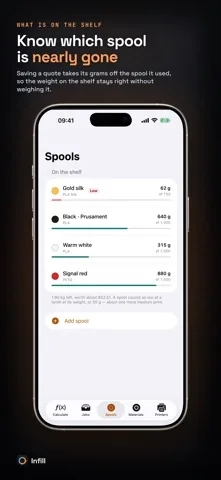
Prices per gram are easy to get wrong quietly. The check that catches it is physical: keep the spools you actually own in the app, with color, weight and what you paid, and let a saved quote draw its grams off the spool it used, waste and flushed material included.
When the number in the app and the spool in your hand disagree, one of your inputs is wrong, and you will find out in a week rather than at the end of the year. Spools running low get flagged before you promise someone a print you cannot finish.
Keep your filament prices in your pocket
Material profiles, spool inventory and the full cost breakdown, free on iPhone and iPad.
Free on the App Store. iOS 17.0 or later, iPhone and iPad. No account, no advertising, no tracking.
Guides
Related guides
- How much to charge for 3D prints
The seven cost lines, the four-step method, and the three sums most calculators get wrong.
- 3D printer electricity cost per hour
Average watts for twelve popular printers, and why power is almost never your biggest line.
- G-code cost calculator
What PrusaSlicer, Bambu Studio, OrcaSlicer and Cura write into a file, and what Infill reads back out.
- AMS purge waste cost
Multi-color prints throw filament away at every change. Here is how to put a number on it.
Price the plastic, then price the print
Infill takes it from grams to a selling price without a spreadsheet.
Free on the App Store. iOS 17.0 or later, iPhone and iPad. No account, no advertising, no tracking.